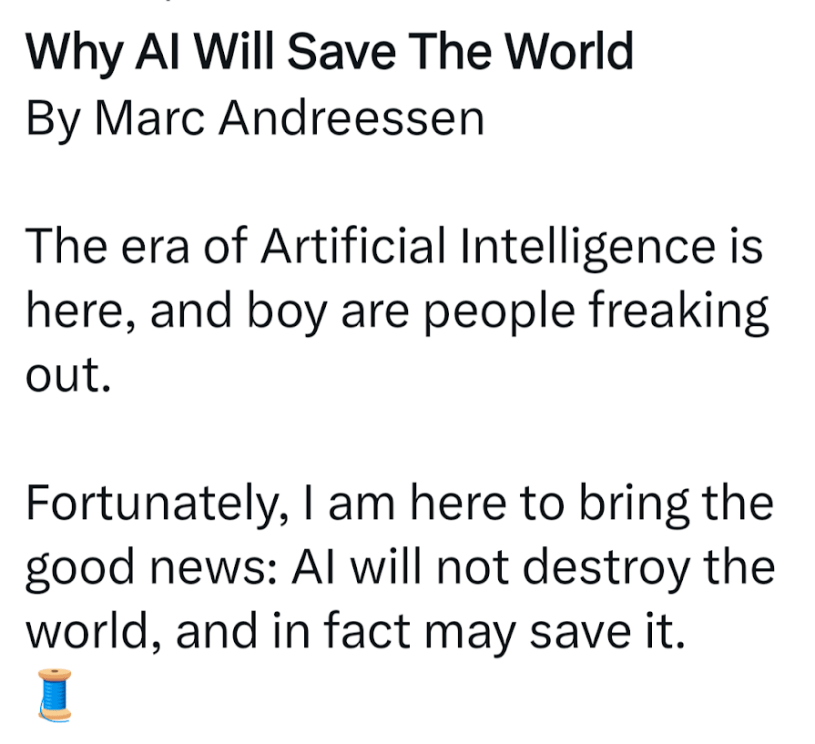
Just over a decade ago, Marc Andreessen published an essay in the Wall Street Journal entitled “Why Software is Eating the World.”
The piece was prescient and timely and became something of a rallying cry for investors. It also helped raise the visibility of the venture capital firm he co-founded with Ben Horowitz.
Today, Andreessen dropped another Big Think piece called “Why AI Will Save the World.”
It’s a 7,000 word opus that makes the case for why AI is not only less of a threat many people believe, but has the potential to dramatically improve life on the planet. “It could mean a takeoff rate of economic productivity growth that would be absolutely stratospheric.”
I’ll leave others to debate the merits of the argument. What fascinated me was the delivery.
Andreessen Horowitz runs circles around most financial firms in leveraging content to boost their profile and define a narrative, whether about software or crypto or AI.
Content is not a byproduct of what they do, it’s essential to attracting deals and investors.
They are better in part because they spend more money and hire editorial professionals. But they also have been smart in their approach.
It’s worth unpacking the essay on AI to show why it’s effective:
–TIMING: To stand out from the crowd, they waited for the conversation about AI to reach a feverish pitch. They didn’t weigh in too early. When they did publish, it was long and definitive.
–WRITING: It’s an enjoyable, jargon-free read. It includes plenty of historical context and a memorable section comparing AI proponents and critics to “Baptists and Bootleggers.”
–PERSONAL ENGAGEMENT: The article was clearly written by Marc Andreessen. He likely had help drafting and editing and shaping etc… but he didn’t outsource the hard work.
–DELIVERY: In 2011, Andreessen picked the WSJ to publish. Now, he’s going “direct to consumer” via Twitter threads, Substack, the firm’s Web site and email distribution.
–MAKING IT AN EVENT: The piece was published into the news cycle at 9 am Pacific time (12 noon Eastern) and includes a Twitter Spaces discussion later tonight.
That’s it.
It’s a simple strategy, but hard to execute.
It requires vision to have a content strategy, a commitment to excellence to pay top editors and the discipline to write and self publish.
CEOs and executives wondering how to connect with stakeholders should take note.
Expect to see more leaders take advantage of platforms such as LinkedIn and Substack instead of relying on coverage from media organizations.
This is the future.
I recently started Principals Media to help executives connect with audiences.
DM me if you want to hear more about how we can help.
 Ted Merz