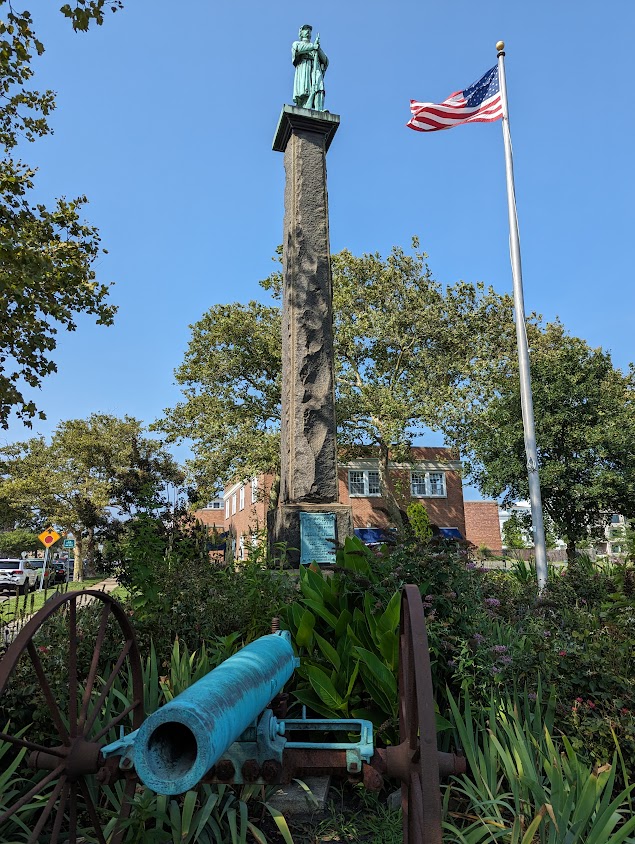
There’s a memorial to Civil War veterans in Asbury Park at the corner of Cookman and Grand.
A statue of a soldier from New Jersey’s 14th Regiment stands at parade rest atop a tall stone pillar flanked by two cannon. It was unveiled on Memorial Day 1893.
The plaque reads: In Memory of Those Who Fought in Defense of the Union. War of Rebellion 1861 – 1865. Erected by C.K. Hall Post No. 41 G.A.R. Dept of N.J. and Women’s Relief Corp No. 25.
You see memorials to the fallen in towns all over America. Most honor people killed in more recent wars, such as WWI, WWII, Korea or Vietnam. Often, they list the names of people in the community who died.
It’s a way to commemorate loss, but also note shared commitment and forge a common identity.
Which brings me to a curious aspect about the memorial in Asbury Park: the town didn’t even exist until six years after the Civil War ended.
That may explain the vague language on the plaque, which doesn’t cite the valor of specific town residents because there were no residents at that time.
In fact, the idea for a memorial was hatched by James Bradley, who founded Asbury Park in 1872. He was a businessman who thought it would help attract tourists.
Specifically, Bradley hoped to capture some of the business for reunions of civil war veterans, which were becoming increasingly popular in the 1890s.
The idea of reunions of soldiers who fought in the war started as early as 1874, with a meeting at the Vicksburg battlefield. The last big reunion was in 1938 at Gettysburg. The veterans, then in their 90s, even re-enacted Pickett’s famous charge.
I’ve spent a lot of time over the years in Asbury Park, a town where my family has deep roots. My grandparents met there for the first time in 1919. They took my father to the city’s legendary baby parade in the late 1920s.
I walked past the monument for years before I knew the backstory.
It makes you think about the history lessons we are taught and the events we commemorate and how we mark them. It makes you think about all the stories we tell ourselves about the past.
The cannons that sit beside the statue are 12 pounder Heavy Dahlgren Boat Howitzers made for the U.S. Navy in 1862. One was used aboard the USS Cricket, a steamer that patrolled the Mississippi River and saw action.
During one engagement, the Cricket was struck 38 times. Out of a crew of fifty officers and men, 12 were killed and 19 wounded.
The ship was decommissioned in June 1865.
Somehow, two-and-a-half decades later, one of those guns made its way to New Jersey to mark the sacrifices of a town that didn’t exist when it was last fired.
 Ted Merz