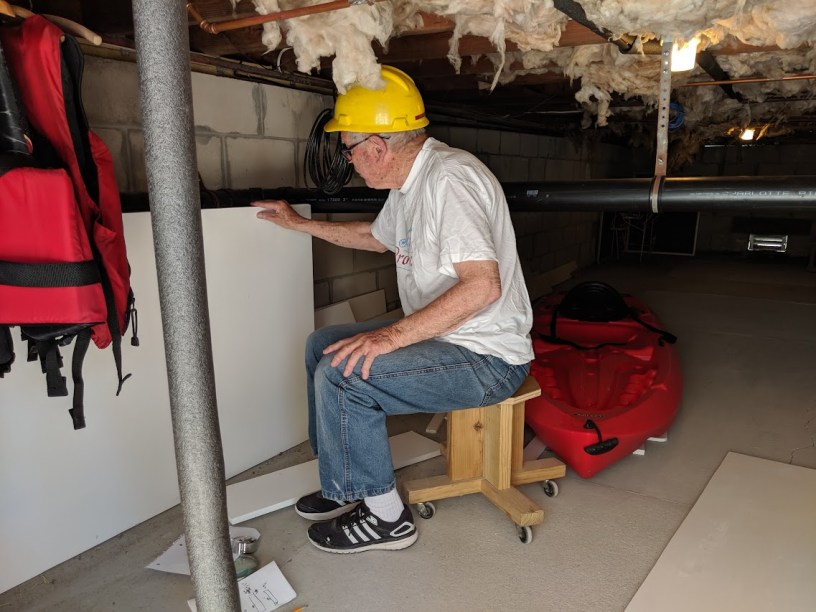
One of the indirect consequences of Hurricane Sandy, which ravaged the Eastern seaboard in 2012, was to provide a safe space for my father under the house.
The hurricane destroyed or severely damaged a large number of houses at the Jersey Shore where my parents retired. The sea crested three feet inside the living room, warping floorboards and spawning mold.
When they rebuilt, my parents lifted the house several feet. They also laid a new concrete foundation.
The result was an expanded crawl space, an area that Dad knew could be put to some good use.
My father saw it as an ideal area for the paddle boards, kayaks, ladders and surf boards that had been stashed behind the garage.
It also gave him a refuge, a place to escape from the family and work on new projects.
We grew up in a classic colonial with a renovated basement that accommodated Dad’s work room and tools. It was a place he could disappear and build shelves for the TV and stereo system, a rack for my beer can collection and pegs to hang the skis in the hallway.
He lost that space when they sold the house and moved to the Shore.
I didn’t give much thought to the crawl space created when the house at the Shore was raised. It wasn’t tall enough to stand. Squatting was uncomfortable.
But Dad, who was then in his mid-80s, was delighted.
He saw an opportunity that most would have missed: The space was high enough, large enough and dry enough to provide excellent storage.
The part I didn’t see coming was how he would adapt to the new environment.
At first, he used a dolly he covered with scraps of carpet to scoot himself around. The problem with the dolly, which is normally used to move furniture, was that it sat too low.
His inspiration was to use discarded lumber to build a rolling stool. That way he could sit upright and propel himself across the concrete with one kick of his leg.
The problem he encountered next was that he kept banging his head on the water pipes. His solution was to wear a yellow hardhat when he went under the house. Sometimes he would also put on knee pads.
He looked like a Special Ops version of home repair guru Bob Vila.
He has started spending more and more time under the house, installing hooks to secure his ladder and organizing the kayaks in one corner. He now uses the water pipes as a pole to hang life jackets.
He has converted space most people would overlook into a place of purpose that provides him a sanctuary and engenders joy.
It’s the Greatest Generation’s idea of a man cave.
(Part of a series of life lessons based on conversations with my parents.)
 Ted Merz