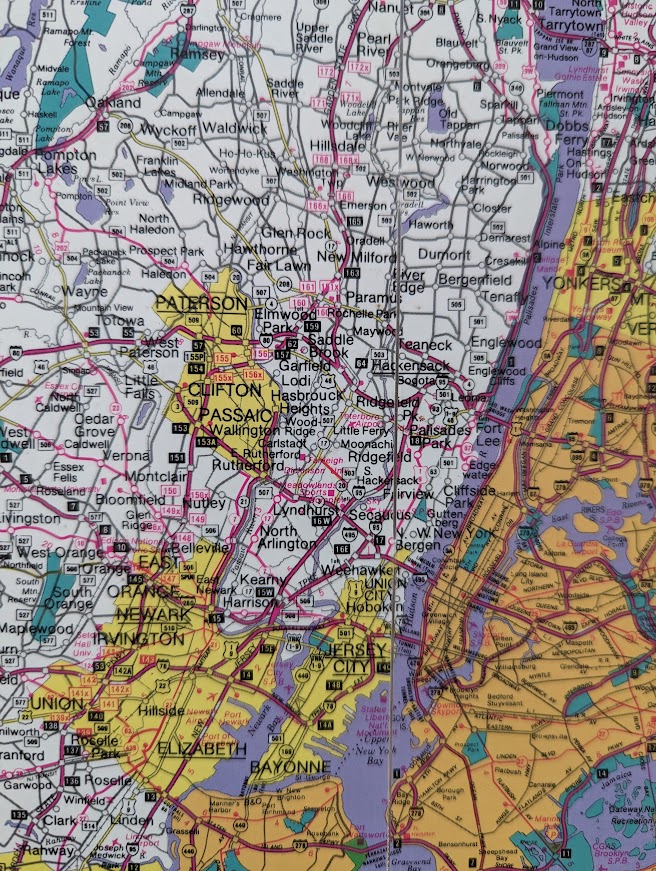
My father had eye surgery about 20 years ago.
His vision had begun to deteriorate due to glaucoma and so we booked an appointment with a surgeon in Newark.
The operation was successful, but he emerged with both eyes bandaged to protect against the light. Completely blind, we had to lead him to the car.
I was driving and mom was riding shotgun to navigate.
Sitting in the parking lot in downtown Newark, we realized we didn’t know how to get back to the highway that would take us west to the New Jersey suburbs.
Dad usually drove and he has an incredible sense of direction and an encyclopedic knowledge of the highways and backroads of our home state.
This was before smartphones. We probably had a folded paper map in the car covering the tri-state area. But not one with details of the inner city.
It was at this moment my father taught me a great life lesson about preparation.
“Reach into the glove compartment,” he told my mother.
There she found a hand-drawn map he had created in advance. The paper contained instructions to guide us out of the parking lot and through downtown.
As it turned out, it wasn’t necessary because even with bandages he provided verbal directions. I needed to exit left on Bergen Street and turn left on South Orange Ave. He told me to pass about six streets until I got to Norfolk.
“Go straight across Norfolk until you get to Springfield Ave,” he said. “There’s a statue of Lincoln coming up at the corner of Market,” he commented. “It’s unusual because he’s sitting down.”
He told me to take a right on Market and head toward Broad Street. From there it was just a few more intersections to McCarter Highway.
He added in color about the city, the courthouse and the Cathedral Basilica of the Sacred Heart.
I could not believe he knew the street names and the layout. Dad was born in Newark, but his family moved when he was three. So, his knowledge would have to have come from visits.
More surprising was the mindset to anticipate we would need a map and provide it.
Spatial awareness has atrophied in the era of Google Maps. People no longer have to remember the grid to determine where they are and where they are going.
There was a decade or so between when cell phones emerged and smartphones proliferated when I would call my father for directions.
Once I was driving in southern Jersey on I-95. There were “Congestion Ahead” signs that I ignored. Then, as I approached Exit 7a, I could see cars backing up.
I was alone, had no map and was about 60 seconds from the exit so I called dad to ask what I should do.
“Go ahead and get off. You can take I-295 to U.S. 1 to go north.” he said.
“Or you can take Route 130 and reconnect with Route 1 at Milltown and then get on the Turnpike. Or just stay on Route 1 and it will take you past 78 to the Lincoln Tunnel.”
Knowing the grid, he knew there were better options than staying on the highway.
(Part of a series of life lessons based on conversations with my parents.)
 Ted Merz