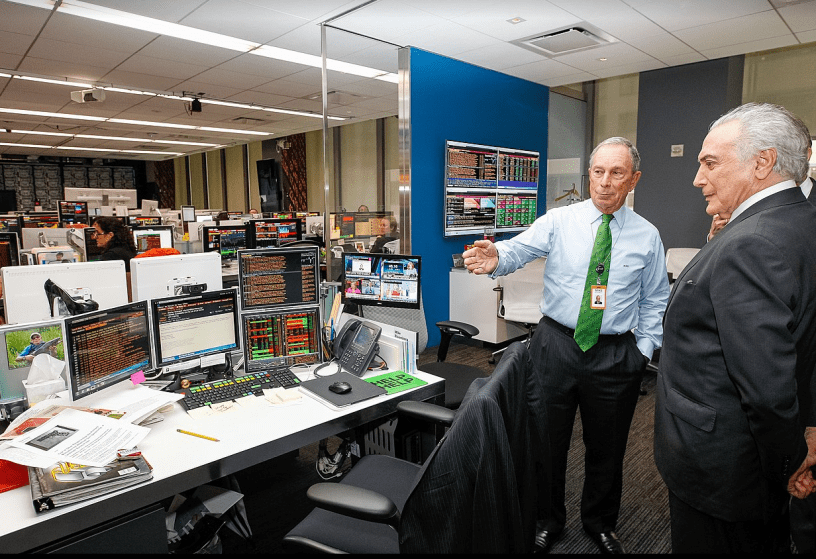
There are no private offices at Bloomberg LP.
It’s one of the cultural touchstones Mike Bloomberg brought with him from a decade working on the trading floor at Salomon Brothers.
When he founded the company, Mike set up the office in an open-seating plan. He famously adopted the same “bullpen” environment when he became Mayor of New York City.
He elaborated about the practice earlier this year in a podcast with Ruth Rogers, a British chef.
“People are often surprised that I sit out in the open. The way I see it, if you’re in charge, why would you want to wall yourself off from your team? Just because it’s a tradition for executives to have offices doesn’t mean it’s good for them or for their organizations.”
Open-seating plans were less common when he launched the company. Bloomberg stood out even more by having executives sit in the open. Once, the CEO of a major Japanese company came to see for himself.
For personal meetings, there are conference rooms that can be booked online.
When Mike returned to Bloomberg after 12 years as mayor, he found some managers had commandeered rooms for their own use by taking them off the reservation system. Some were even decorated with family photos.
He was not amused.
He put the rooms back on the reservation board.
“If the CEO walls himself or herself off, what kind of CEO is that?” he told Rogers on the podcast.
There’s a debate these days about the benefits of open offices. Some studies show that people are less productive.
There are industries which require a private office. Healthcare is one example. The question is whether the benefits are outweighed by the reduction in communication and erosion of a collaborative culture.
One underappreciated aspect is that leaders are more visible. For years it was considered best practice at Bloomberg for senior executives to sit in the middle of the room.
In the early 1990s, I sat (along with a dozen other reporters and editors) in the same room as Mike. You could hear him when he got excited. You could see him meeting with clients.
Sitting near the CEO doesn’t guarantee that management will be aware or sympathetic to employee concerns. But it’s probably more likely than if they are isolated in a tower.
As Mike said on the podcast: “In sports, the coach is on the field with the players, giving directions, drawing on white boards, huddling during timeouts, motivating and inspiring – and encouraging someone who made a mistake. The same should be true in business. And if someone needs to ask me a question, I want them to be able to walk up and ask it.”
Effectively, by knowing where he sat, you knew where he stood.
(Part of a series of management lessons learned from three decades at Bloomberg)
 Ted Merz