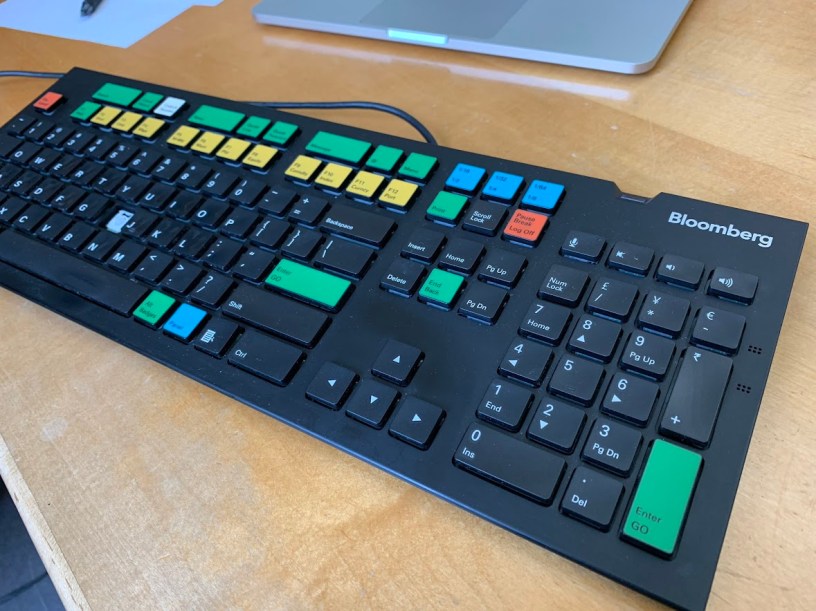
Bloomberg LP has quietly turned on its first generative AI application.
Clients of the terminal can now create AI summaries of conference call transcripts.
A friend who is a money manager walked me through a demo showing how summaries are accessible via the Document Search function for transcripts (DS TA ).
The feature is a small, but significant development for financial professionals.
It illustrates both the opportunity and challenge of integrating generative AI into terminals used by more than 325,000 Wall Street traders and investors.
Large legacy data providers such as Bloomberg, FactSet and others are trying to balance the opportunity of incorporating the technology which emerged in late 2022 when OpenAI unveiled its ChatGPT application with the risks that it produces hallucinations.
Bloomberg has taken an incremental approach. The new summaries are delivered from hard-coded prompts on a narrow range of documents. Unlike ChatGPT, the system doesn’t allow users to submit follow up questions.
Here’s how it works: While running the Document Search function clients can select a specific company. From the drop down they pick any of the recent documents that display a summary icon. They then click a tab to summarize.
A summary with predefined categories including guidance, capital allocation, labor, the macro environment, supply chain, pricing and product development will appear.
It’s easy to use and includes a nice feature: when you click on any of the sections it provides a link back to the original transcript to provide transparency. You can also download a PDF.
There appears to be no way to ask followup questions, which is a pretty large limitation and one of the defining features of ChatGPT.
Nor can the summary handle multiple documents at the same time which would help identify longer-term trends. It doesn’t tap into the broader Bloomberg database for numbers and news.
In the case of the conference call transcripts, the summaries don’t include the questions asked by analysts which are often the most illuminating part.
So, you cannot ask: “What are the biggest issues Tesla faced in the past quarter? Or what did the analysts ask Apple CEO Tim Cook? Or did Google talk about its business in China?
Bloomberg’s earnings call summaries are better than the ones produced by other LLMs such as Microsoft’s Bing or Google’s Bard. That’s largely because it limits itself to the conference call transcript. It doesn’t use the open web, which can introduce more errors.
It’s not clear from the screens whether the company is using its proprietary BloombergGPT large language model or some other model to generate the text.
There are scores of startups leveraging generative AI to analyze transcripts as well as other documents that provide more flexibility and greater depth of insights.
Of course, they don’t offer the same level of customer service, consistency or reliability.
Bloomberg is likely taking the cautious approach because there is so much at stake.
The larger the data sets and the more open-ended the queries the greater risk of hallucinations.
Still, without the ability to customize questions you lose some of the magic.
(Part of a series of lessons I learned from three decades working at Bloomberg LP)
 Ted Merz