It’s called crisis communications for a reason.
And, as the global Internet outage last week reminded everyone, it’s hard.
CrowdStrike was criticized not just for shipping software that crashed PCs, but for communicating poorly.
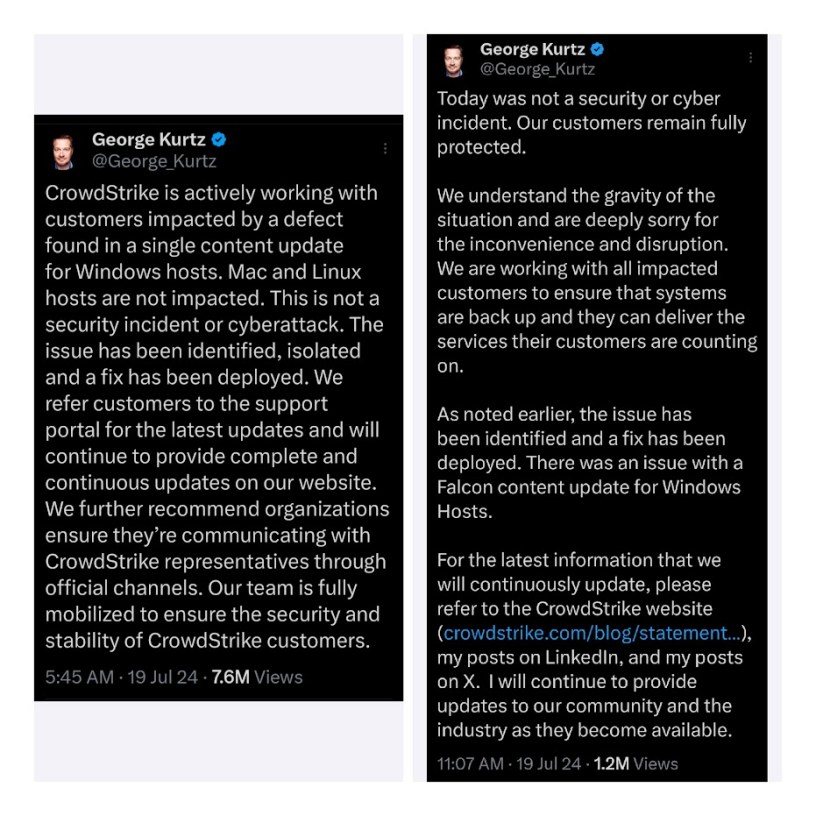
The first response came via a tweet from CEO George Kurtz at 5:45 a.m., hours after it started. Kurtz said the outage was “a defect found in a single content update for Windows hosts.”
Filled with jargon, the statement didn’t seem to accept responsibility and directed clients to “the support portal.”
Big companies run PR disaster simulations to prepare for such events.
Someone drafts a scenario like — “there’s E. coli in the bananas!” — and they run a war game-style response to stress test how everyone reacts. The CEO huddles with lawyers and the PR team to draft a statement.
The simulations, according to friends in PR, aren’t convened in the middle of the night. They are scheduled. People are available. You have a couple hours.
The problem: Life comes at you fast. Simulations aren’t done when the rest of the world is freaking out staring at the Blue Screen of Death.
Companies facing PR disasters are not new.
What is new:
–Companies need to respond faster
–Communicating via X
–The CEO posting directly
These days most important thing – really the only thing that matters out of the gate – is writing an effective, accurate tweet very quickly. Everything else comes second.
The tweet needs to a) explain the situation in plain English b) acknowledge responsibility c) provide a sense of what comes next.
Before the emergence of X as the default global town hall, a statement would be sent to the news media. Reporters would write an article and provide context.
Now, the statement needs to stands alone.
Most CEOs have scant experience writing tweets that will get this level of scrutiny.
I think this is going to change.
Kurtz posts on X and has a following. But his posts are anodyne and impersonal – tweets about earnings; the race car team CrowdStrike sponsors; various honors the company has received and interviews he has done.
The lack of direct social media experience probably left him relying on the lawyers and PR folks to draft the post.
This is where I expect to see a change. As CEOs gradually understand how they may be defined by a tweet they post during a crisis, they will take it more seriously.
Writing online is a bit like public speaking. To do it well, you need practice.
You can delegate it to others on most days and it won’t matter.
But eventually there may come a day that it does.
 Ted Merz