Amazon CEO Andy Jassy dropped a bombshell yesterday when he said the company would become the first mega cap to require all employees to work from the office five days a week.
“We continue to believe that the advantages of being together in the office are significant,” Jassy said in a letter to employees. “If anything, the last 15 months we’ve been back in the office at least three days a week has strengthened our conviction about the benefits.”
The decision, effectively reversing the flexibility to work remotely that was implemented during the pandemic, was met on social media with a considerable amount of discontent.
That’s not a surprise given Amazon employees were vocal in opposing an earlier decision requiring them to return to the office three days a week. At that time, almost 30,000 employees signed a petition against the decision.
In addition, there has been evidence that employees in general prefer flexibility.
LinkedIn’s CEO Ryan Roslansky highlighted data in 2022 showing job applicants favored remote work. He said more than 50% of job applications on LinkedIn focused on the 14% of listings offering remote options.
Jassy’s decision will likely result in a not insignificant amount of departures, particularly among people who moved during Covid and would be disrupted by moving back to Seattle and other offices.
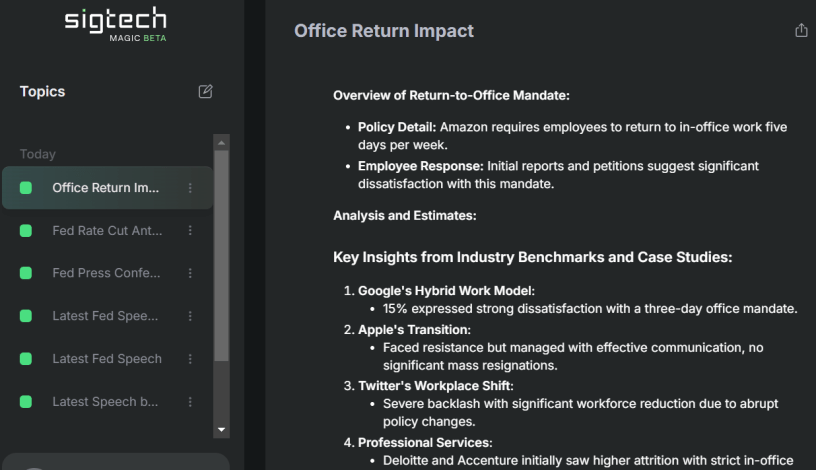
I asked SigTech’s Magic platform to analyze the situation. The software, which leverages AI to help build financial models, pulled from historical examples that included Google, Apple, Twitter and Deloitte.
Magic identified key Insights from industry benchmarks and case studies:
–Google’s Hybrid Work Model: 15% expressed strong dissatisfaction with a three-day office mandate.
–Apple’s Transition: Faced resistance but leveraged communication to reduce mass resignations.
–Twitter’s Shift: Severe backlash with significant workforce reduction due to abrupt policy changes.
–Deloitte and Accenture initially saw higher attrition with strict policies until flexibility was introduced.
Based on insights from those and other companies, the SigTech model gave three scenarios for the number of departures Amazon may see when it implements the policy at the beginning of the year:
Conservative Estimate: 20% attrition rate
Moderate Estimate: 30%-35% attrition rate
Aggressive Estimate: 40%-45% attrition rate
Those numbers seem high to me but it’s worth remembering that Twitter has continued to operate after a stunning 80% of the company’s employees either left or were fired after the acquisition by Elon Musk.
It’s also hard to predict the state of the overall economy and whether other tech and retail firms are hiring or laying off. If someone moved to Boulder, for example, they may stay if they can get another job there.
The actual attrition rate may also depend on how Amazon implements the strategy.
Whatever the outcome, the decision will be closely followed by the CEOs at other big tech and finance companies, many of whom have argued that returning to the office full time is important to boost productivity.
 Ted Merz