In professional sports there is a concept of “coaching lines.”
The idea is that you should judge a coach by how well they train assistant coaches and how well those people do when they leave to manage other teams.
It also applies in business. Jack Welch famously taught a generation of managers at General Electric while Julian Robertson, the founder of the hedge fund Tiger Global Management spawned scores of Tiger Cubs. In tech, we have the Paypal Mafia.
Last year, I met several founders including Craig DeWitt, the co-founder of Skyfire, and Scott Clark, who co-founded Distributional, and was surprised to learn both spent time early in their careers at Bloomberg.
Bloomberg is an excellent company, but having worked there myself for three decades it never struck me as a breeding ground for entrepreneurs.
I wondered whether Bloomberg had its own version of coaching lines.
To answer that question, I turned to Jason Saltzman at Live Data Technologies. The company maintains a jobs database of more than 90 million white collar professionals.
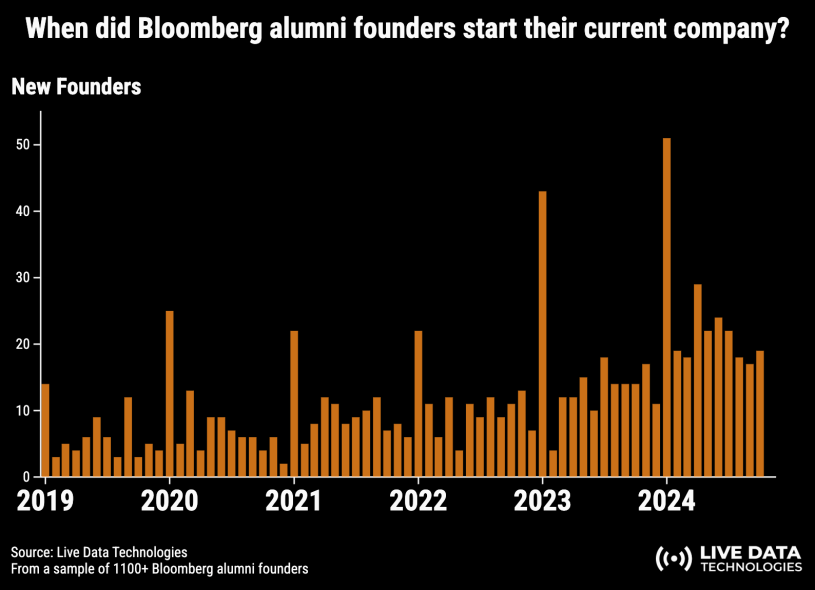
I was surprised when Jason said 1,133 ex-Bloomberg employees (out of 43,965 current and former employees in the database) started companies in the past five years. Moreover, as the accompanying chart illustrates, the trajectory seems to be increasing.
Jason broke down the data to provide a granular analysis showing almost one third of the founders were engineers, while 15 percent worked in sales. (For the purists, Jason’s classification system doesn’t track exactly with how Bloomberg buckets employees.)

Only 4% worked in the News Department which didn’t surprise me, though notably one of them was Jack Clark, a co-founder of Anthropic. (I also found myself on that list after co-founding Pricing Culture, an AI content generation company.)
The data showed that 40% of the alumni founded tech startups and most were based in the New York area, where Bloomberg is based. The company has a small San Francisco outpost.

Generally, the founders spent relatively short times at Bloomberg, typically a few years as a junior engineer or in the sales training program. Craig DeWitt spent three years as a product specialist. Scott Clark at Distributional was only there for a short time as an intern.
Some of the founders that stood out included: Ashley Zahabian (Integrate), Yang Han (StackAdapt), Dan Ryan (VergeSense), Justin Kim (Hupo), Keith Laban (Distributional) and Alessandro Asoni (Clockwork Labs).
I suspect that the fact that we are seeing founders emerge from Bloomberg also says a lot about how the modern economy, especially in America, has become an entrepreneurial engine.
It’s probably what happens naturally when you combine a market that tilts economic rewards towards initiative with a surplus of engineering talent and abundant venture capital.
It’s possible that other companies like Bloomberg that have hired large numbers of engineers in the past decade are also spawning entrepeneurial talent for new startups.
To find out I’ll have to ask Jason if he’s willing to crunch more numbers.
 Ted Merz