Marc Benioff was ready for his Joe Lonsdale moment. Are you?
That’s what I ask CEOs who don’t spend much time on social media.
If you don’t know, Benioff is the founder of Salesforce; Lonsdale is the co-founder of Palantir.
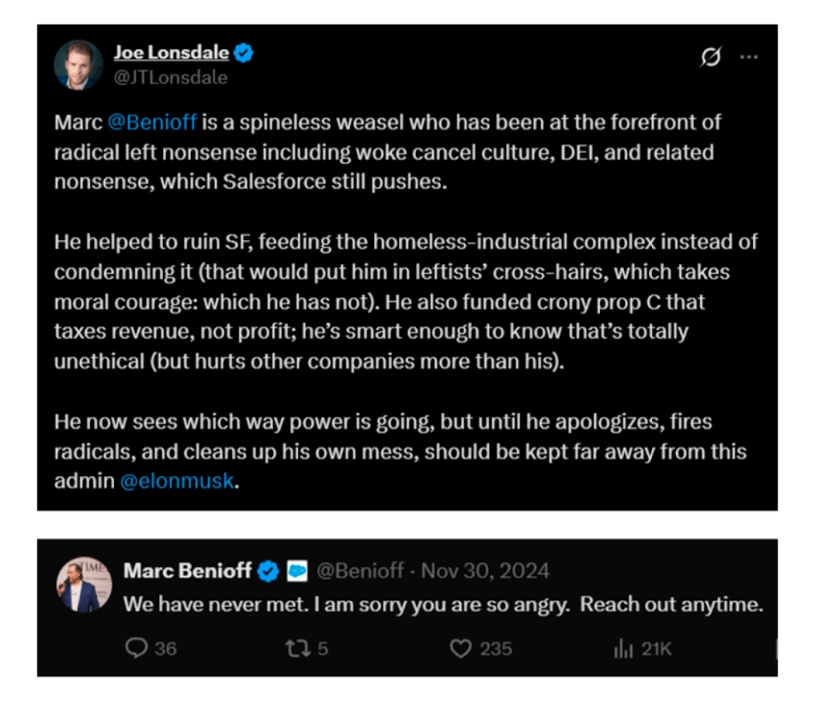
On Nov. 30, Lonsdale started his day by tweeting:
“Benioff is a spineless weasel who has been at the forefront of radical left nonsense including woke cancel culture, DEI and related nonsense, which Salesforce still pushes.”
The tweet went on to blame Benioff for ruining San Francisco by supporting a proposition to levy a business tax that helped perpetuate “the homeless-industrial complex.”
No one expects to wake up to a prominent entrepreneur calling them a spineless weasel.
There didn’t appear to be an immediate, specific catalyst.
If Lonsdale were a random person on the internet, Benioff would ignore him.
He is not. He’s the co-founder of one of the hottest tech companies and a frequent guest on CNBC with 222,000 followers on X. He has a megaphone and enjoys using it.
Also, a gaggle of big social media voices including Elon Musk, Jason Calacanis and Bojan Tunguz weighed in on the post, which garnered more than 1 million views.
The comments from the largely West Coast-based twitter crowd seemed to run about nine to one against Benioff.
Four hours later, Benioff gave what should be a social media Hall-of-Fame response.
“We have never met. I am sorry you are so angry. Reach out anytime.”
It was a model of restraint, cool, calm and collected. With 14 words he deflated the drama. The response conveyed that Benioff is in the game, but not thrown off his game by the attack.
Welcome to the frontier of executive comms, where things once muttered in private are plastered in public.
In the past, comms teams would get a heads up from the legacy media when a “negative” article was going to appear, giving them time to tailor a response.
Now, there is no warning. Attacks come like Midwestern squalls from across the digital universe.
Companies can, of course, choose not to respond. But there is a cost to sitting on the sidelines.
They should, however, not be surprised.
The broadside by Lonsdale represents a new reality in the communications landscape: personal attacks that come from politicians, rivals and random executives.
In January, Trump attacked Bank of America CEO Brian Moynihan in a live video call at Davos, arguing the company had de-banked Republicans. Moynihan deflected.
This week, Elon Musk attacked former PayPal partner and LinkedIn founder Reid Hoffman, saying he was funding a campaign against the Tesla founder. Hoffman punched back.
People have always had beef, but complaints were mostly lodged in private. Now, things are shared in public.
Attacking other business people for their politics is not a strategy I would recommend, but it’s not going away.
Lots of CEOs say that they are too busy running their company to spend all day on social media.
I wouldn’t suggest they do.
But at a certain point it’s also their job to be ready when their Joe Lonsdale moment comes.
To paraphrase Trotsky’s famous quip about the pacifists who ignore the threat of war, you may not care about social media, but social media cares about you.
 Ted Merz