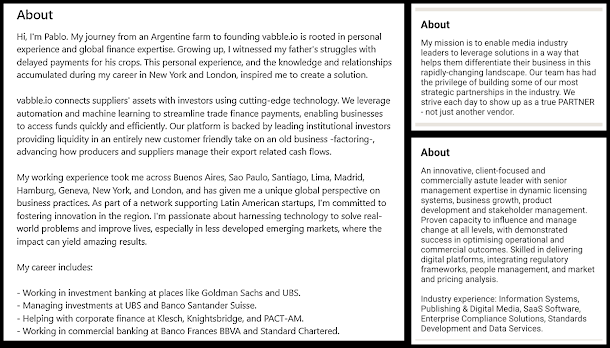
“Hi, I’m Pablo.”
That’s how Pablo Terpolilli begins the ABOUT section of his LinkedIn profile, one of the better ones I’ve seen.
It’s easy to see why I think it’s good by comparing it to the generic alternatives that dominate the platform.
I collect screenshots of LinkedIn ABOUT sections the way other people hoard stamps or coins.
I use them to illustrate to clients that the point of writing online is to communicate something about yourself so it’s easier for other people to connect with you.
The vast majority of ABOUT sections start with predictable pablum about how the person is “a team-orientated veteran communications expert.”
Check out the photo that accompanies this post to compare how different Pablo’s ABOUT is with two random other people whose names I have redacted.
The key test should be whether the section could be cut and pasted into someone else’s page without anyone realizing. If it can, that’s bad.
It’s a missed opportunity to tell your story, as Pablo does effectively. He includes what he is doing, a sense of why and mentions the career stints he spent at Goldman and UBS.
I read the profile before Pablo and I met this week on a Zoom call and it prepared me with everything I needed to have a great conversation.
There is no one right way to write your personal story in an ABOUT section.
But there are wrong ways.
I cannot overstate how disastrous it is from a personal brand-building point of view to write something that provides no useful information.
The main reason people look you up is to gather or verify details about what you have done.
Failing to provide key information makes it harder for other people to connect with you.
Best practices include:
–Include the basics firm, title, job and then examples of work you have done.
–Expect people to cut and paste the content when researching you.
-Include key information you would provide in real life.
–Include details that make you unique.
–Include relevant cultural markers.
 Ted Merz