How can you get coverage in the Wall Street Journal?
The old model is to pay a PR agency tens of thousands of dollars to craft a “campaign” and call a reporter to persuade the journalist it’s newsworthy.
“Getting in the Journal is the Holy Grail of Holy Grails,” Nima Olumi, founder of PR firm Lightyear Strategies told me. “Some PR people would kill to get a client into the WSJ.”
Hiring a PR firm has never been a guarantee of coverage, of course. Reporters don’t love to be pitched stories; they prefer to discover ideas to write about on their own.
An emerging strategy – and certainly a less expensive one — is to have CEOs post “news” on social media. We’ve seen this from Mark Zuckerberg, Sam Altman and others.
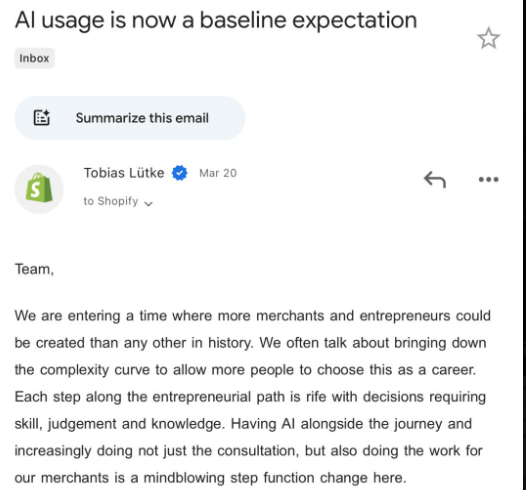
Yesterday, Shopify CEO Tobias Lütke tweeted at 9:07 a.m. that an internal memo that had leaked and so he was taking the proactive step to publish it.
I am not suggesting Lutke or Shopify leaked the memo — which carried the header “AI usage is now a baseline expectation” — to get coverage. (It was released internally in March.)
But I am saying that if he had wanted press coverage there was no better way to post it online so it could be “discovered.”
That’s because having a PR agency call a journalist to pitch the “story” of how the company is requiring employees to use AI is not nearly as exciting as posting a “leaked” internal memo!
CEOs are increasingly posting online to communicate directly with stakeholders. Often, they can then let the current carry it. If it’s interesting, first the influencers and eventually the mainstream media will write about the post, as the WSJ did today.
An added benefit is that the stories tend to adopt the point of view you originally crafted, something that is less likely if you submit to an interview.
Lutke — along with Shopify President Harvey Finkelstein — is one of the more prolific CEOs posting on social media. His platform of choice is X, where he has 383,000 followers. He has 38,000 followers on LinkedIn even though he has yet to post there.
One irony of the memo is it doesn’t appear to have been written with AI.
It’s arguably too long and rambling and the key point in the header doesn’t show up until page three when he writes: everyone has to demonstrate they are using AI and don’t try to hire anyone unless you can show AI can’t do it.
The internal email is crafted in the same unmistakable voice and cadence Lutke has been using for years to communicate when he writes online.
It’s that tone that establishes an authentic connection with the audience that is so essential and yet so hard to create when you rely on ChatGPT.
Shopify Lands in the WSJ
 Ted Merz