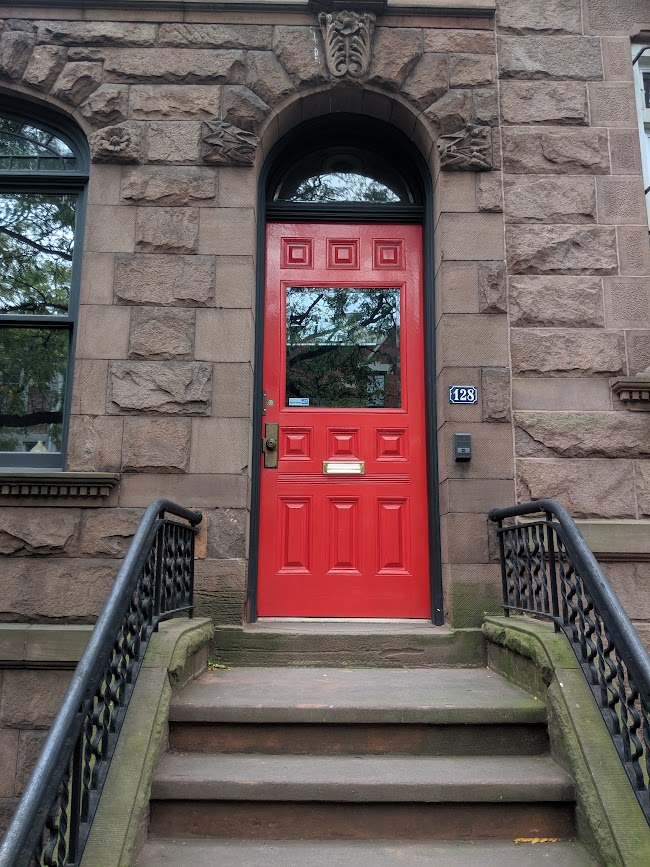
There’s a house on Manhattan Avenue that used to sport a spectacular bright red door.
It stood out because every other home on the block had a dark, wood-stained entrance.
A decade ago I asked the owner how the door came to be painted red.
He explained that it was the final element of an extensive restoration that involved stripping all the woodwork to return the townhouse to the way it looked when built in the 1880s.
He spent a lot of time in particular thinking about the front door. He did research on the options and selected a hue of red paint that was expensive and available only in Europe.
It was not an easy project. The door had to be taken off the hinges to be painted. It took a week to dry.
My neighbor left the city in the summer of 2016, moving to a small town in New Jersey where he bought the town’s abandoned train station. He began a renovation that took several years.
The project combined two of his loves: building things and trains. While at college his senior thesis was called: “A General History of the New York Regional Rapid Transit System.”
The Manhattan Avenue house was sold to a family from Wisconsin and then sold again after they moved back to the midwest in the middle of the pandemic.
The new owners embarked on a major renovation. All the woodwork that had taken my former neighbor years to restore — from the moldings to the shutters — was covered by white paint. Modern lighting fixtures were installed.
A decade or so of labor undone in a matter of months.
The red door was was replaced with the same brown-stained wood as every other home on the block.
The house no longer stands out, it recedes into the row.
My former neighbor never saw the changes. He died in 2020 of cancer at the age of 69, soon after finishing the restoration of the train station. That has since become a restaurant.
The local newspaper where he lived published a wonderful obituary. There were so many things about him I didn’t know and so many things that explained his love of trains and skill at metal and wood working.
He was raised a Quaker. He worked as a reporter and in a metal shop, building sculptures for the artist Isamu Noguchi. He loved jazz and was an early authority on electric vehicles. He rebuilt a 1956 Ford pickup that was written about in the New Yorker’s Talk of the Town. He liked to fly to Cleveland to watch the Indians play baseball.
“For many of his friends and family he is irreplaceable,” is how the obit ended.
Like many obituaries, it leaves you with regret that you didn’t know the person better.
My neighbor was lucky to discover interests that he loved – such as woodworking and trains – and also have the opportunity to pursue them.
It’s that pursuit that matters.
Don’t dwell about the possibility your work may be painted over.
Focus on the effort.
It’s the effort people will remember.
 Ted Merz