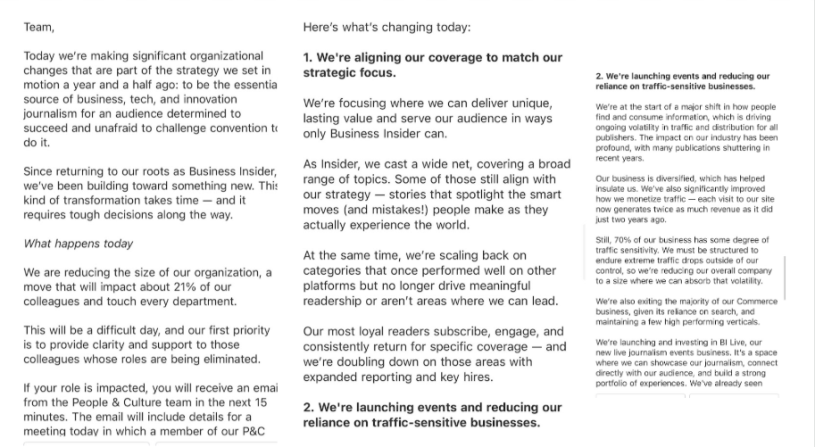
Business Insider dropped a bombshell this week when it said it would lay off more than a fifth of its journalists.
A memo written by CEO Barbara Peng and posted by New York Times media reporter Ben Mullin, blamed the decline in “traffic-sensitive businesses.”
In plain English that means the company is seeing a steep decline in the readership i.e. clicks on stories that tend to be driven by traditional Google search and as a result cannot generate revenue from the ads that are shown beside those stories.
It’s probably the most dramatic example of what people in the traditional media business have been expecting since the launch of OpenAI’s ChatGPT.
The issue is large language models provide immediate answers without requiring additional clicks, removing the opportunity to place and sell ads.
This is an existential crisis for a huge number of digital advertising-supported industries in general and the online media industry in particular.
It’s worth pointing out that while this is a body blow to many traditional media companies it isn’t the end of journalism. Just the end of journalism as we know it.
It’s hard to see a path forward for advertising-driven content as ChatGPT usage increases and consumers come to expect direct answers, not search results.
The journalism that will thrive in this new environment will be content written by experts that is narrowly focused and paywalled. It has to be content people will pay for.
 Ted Merz