WALL STREET STOCK AND BOND TRADERS USED TO WRITE EMAILS AND MEMOS TO ONE ANOTHER IN UPPERCASE LIKE THIS.
It seems hard to imagine now, but in the early 1990s the Bloomberg terminals that Wall Street used to communicate didn’t have lowercase.
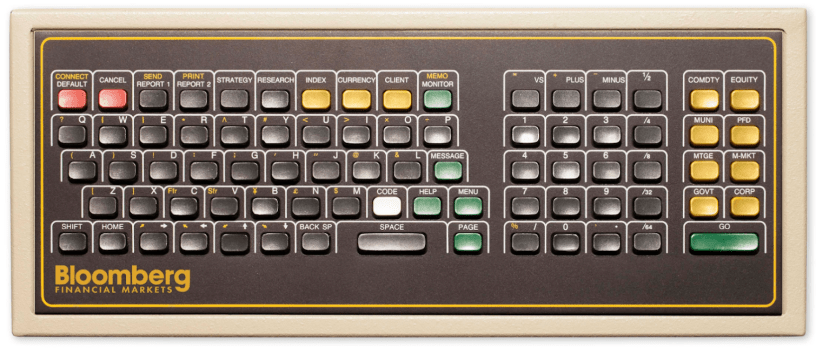
Bloomberg’s famous message function was released in early 1993. At the time, the keyboard was designed more for entering bond and stock tickers than typing text.
The default was ALL CAPS. The keyboard did have a shift key at the lower left, but its purpose was to enable alternate characters i.e. the symbols at the top of each key.
It took another year to add a capability that supported mixed use cases.
It was, however, pretty clunky so most people didn’t bother.
To change the case, you had to simultaneously toggle the shift and downarrow keys. It felt a bit akin to the awkwardness of searching for TV shows using a clicker.
The situation spawned a fascinating cultural A/B experiment of sorts.
Most Bloomberg employees and customers – particularly the early adopters – continued to use default upper case messaging. It was fast, efficient and traditional.
Newer hires would often take more time and extra steps to adopt a more formal, proper sentence case. It was additional effort, but more polite.
The result was a culture clash where the newbies felt “yelled at” by the originalists.
I was accused of “YELLING” myself and encouraged to change my habits.
It’s a great reminder that human communication is complex and nuanced. It’s not just what you say but how it is said that matters.
A friend told me something similar happened at Morgan Stanley. Their system was default lower case so the traders – eager to show they were in a hurry – never capitalized anything. People who did were looked down on, the implication being they had too much time on their hands.
The upper vs lower case grammar debate at Bloomberg wasn’t put to bed until several years later, when traditional computer keyboards were adopted as standard.
That made it easy and normal to be both proper and more polite and meant anyone writing in upper case was making an aggressive statement.
We see echoes of how punctuation conveys meaning today with the widespread adoption of AI.
People including OpenAI CEO Sam Altman intentionally tweet in lower case or include non-standard abbreviations or even typos to signal it’s been written by a human, not AI.
It’s a modern example that how we write sometimes conveys as much if not more information as the specific words on the paper.
 Ted Merz