Sometimes you can win big by playing the game differently.
My father shared a story about one of the most famous football games in history.
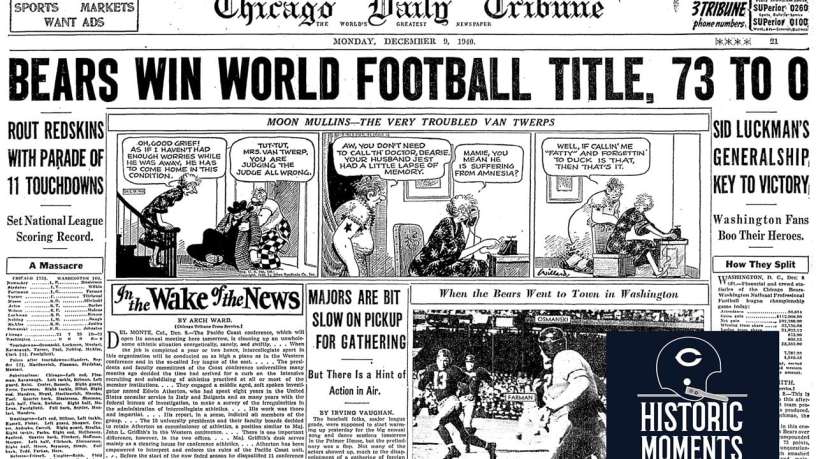
We were asking him about great sports moments he had witnessed such as Joe DiMaggio in the middle of his 56-game hitting streak and Jackie Robinson playing in the minor leagues and he brought up the 1940 NFL Championship.
Dad heard the game live on the radio. He was 13 years old.
After he told me about it, I found a podcast called Pigskin Dispatch that has an episode describing how the Chicago Bears defeated the Washington Redskins 73-0. It remains the largest margin of victory in the history of professional football.
Today, the game is remembered less for the score and more for the fact that it demonstrated the power of the so-called T-formation in which quarterbacks line up directly behind the center to run the offense.
Dad explained that before the T-formation teams used a strategy called the single wing, with the ball mostly being snapped back to a running back who either ran or threw. There was no quarterback in the modern sense.
The story of the actual game is epic. Three weeks earlier, the two teams had played a regular-season game. Washington won that game 7-3. Redskins owner George Preston Marshall called the Bears “crybabies” and “quitters.”
Bears coach George Halas had copies of the comments printed and plastered across the locker room. Then he showed up to the rematch with a completely different offense.
Halas had spent two years preparing for that day, working with Clark Shaughnessy, then the coach at Stanford. In 1938, he traded two players to Pittsburgh for a first-round pick. He had his eye on Sid Luckman, who he had been following since high school.
Luckman was a single-wing tailback out of Columbia University chosen specifically to run the new offense Halas was building.
Halas had two obstacles to overcome. Not only had Luckman never run the T-formation, but he didn’t even want to play professional football.
Luckman planned to join his family’s trucking business in New York. Halas flew to New York to meet Luckman and persuaded him to join the team.
The Bears scored on their first possession with a 68-yard run and they never looked back. Ten different players scored touchdowns. At one point in the fourth quarter, players in the huddle asked each other: have you scored yet?
The Bears scored so many times that they ran out of official game balls. That happened because in those days there were no nets behind the goalposts so every time they kicked an extra point the ball disappeared into the crowd.
Officials resorted to using Washington’s practice balls until those too ran low. Eventually the officials said extra points couldn’t be kicked, they had to be run. That way they wouldn’t lose the football.
The 1940 championship game transformed the sport. Within two seasons, most teams in professional football had moved to some version of the T-formation. Shaughnessy’s Stanford team had gone undefeated, accelerating a similar shift at colleges.
Luckman led Chicago to four NFL championships in 1940, 1941, 1943, and 1946. He was inducted into the Pro Football Hall of Fame in 1965.
Until my father told me about the Bears-Redskins championship match, it hadn’t occurred to me that the game used to be played so differently.
I think that’s one of the benefits of asking older people how things have changed.
Especially someone who is 99 and has seen as much as my dad.
 Ted Merz