Sometimes you can say a lot by talking less.
A good illustration is the approach taken by the leaders of the four big bulge bracket Wall Street firms – Goldman, JPMorgan, Citibank and Morgan Stanely — on earnings calls.
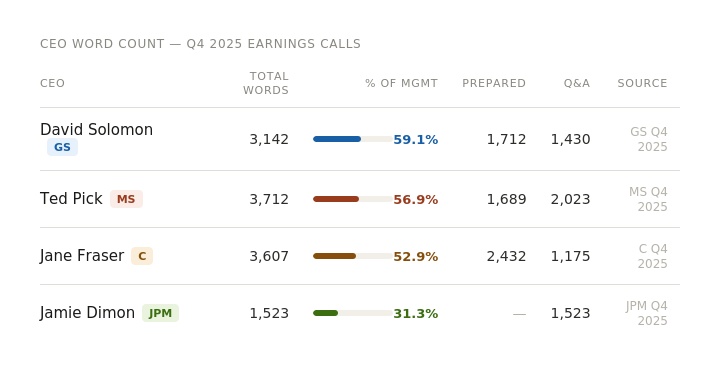
I used software created by startup DoTadda Knowledge to create this analysis showing when and how those CEOs spoke during their most recent quarterly earnings call (Q4 2025). Dotata taps into a ten-year database of conference calls to provide the data.
The big thing that jumps out is how Jamie Dimon at JPMorgan approaches the meeting: he doesn’t make an opening statement, delegating that to CFO Jeremy Barnum.
Dimon limits his contributions to the Q&A section and in part because of that speaks, much less, accounting for just over 30% of the total speaking time from JPM management.
By contrast, David Solomon at Goldman, Ted Pick at Morgan Stanley and Jane Frazer at Citibank account for more than half of the words spoken by management on their calls, roughly splitting their time between an opening statement and questions.
What becomes clear looking at this data is that Dimon is playing a different game. It’s not necessarily right or wrong, but it’s a strategic choice to delegate details to his CFO and take center stage on larger policy points in the Q&A.
It’s a reminder that effective executive communication depends not just on execution but strategy. In that sense, how you convey information can be as significant as what you are sharing.
I geek out over this kind of data because it illustrates what’s coming, i.e. more performance analysis on comms which previously was either hard to get or much more expensive.
One way to understand where we are going is to compare CEOs to the quarterback in American football.
If you watch American sports in general and football in particular football you cannot help notice how stats generated by AWS have transformed the game.
The games now are accompanied by a blizzard of statistics, many of which didn’t exist until relatively recently, such as the quarterback performance metrics.
Some of these measures have been available for a while. But AI makes them cheaper and more accessible and will allow more people to develop creative tools based on them.
 Ted Merz