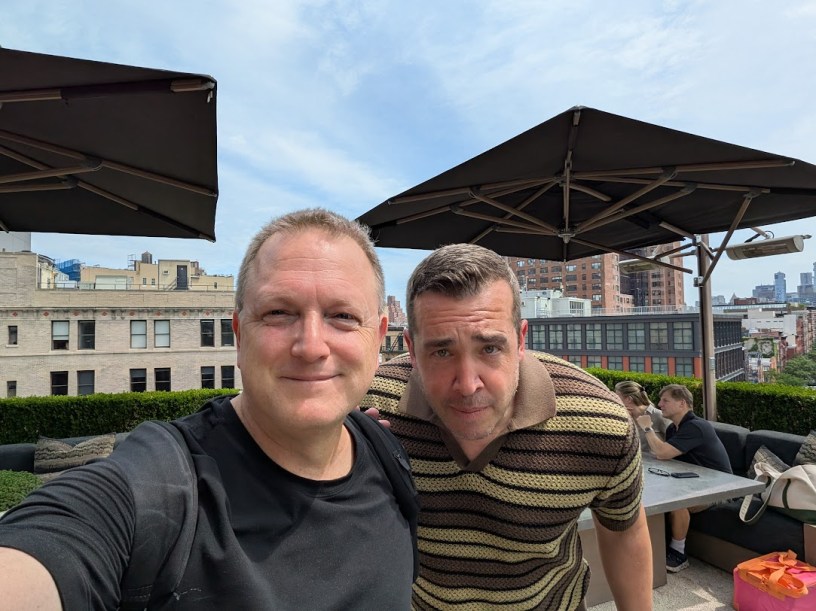
The View from the Office.
I met up with John Kraski at Soho House in the Meatpacking District. I had an iced latte. He had an iced La Colombe oat milk latte.
John and I first met on LinkedIn while he was living in Dubai. I liked his posts and sent him a DM. We ended up jumping on Zoom and eventually met in person when he came through New York.
Since then, he’s relocated to Los Angeles and built a career helping talent and brands build audiences, partnerships, and new business opportunities. He’s worked with creators, celebrities, brands, and media companies including Snoop Dogg, Mark Cuban, and Dhar Mann Studios.
We often talk about how writing online has opened up opportunities we couldn’t have predicted. For people active on social media it’s intuitive that connecting online leads to meeting up in the real world. If you aren’t super active on social media, that might be less obvious.
Another reoccurring theme is how social media is being transformed by the growth of user generated content and convergence of media, comms and PR.
It’s an evolving landscape but generally legacy media companies like the New York Times, Bloomberg, Reuters, CNBC create content and monetize it through advertising or subscriptions.
In the early days of social media, traditional media dominated the readership and flow on platforms like Facebook, MySpace and others. In recent years the growth has come from user generated content, which is sometimes described as New Media.
Claude describes New Media like this:
“New media is defined by the collapse of the gatekeeper. Old media required an institution between the source and the audience i.e. a publisher, network or wire service. New media removes that layer. Distribution costs approach zero, anyone can publish, and the relationship to the audience is direct rather than brokered.”
One key aspect of New Media is that the content has to be good enough that people – or algorithms – want to read and re-distribute it on its own. You can’t rely on an institution.
Another is that tastes and the algorithms are constantly changing.
One of the trends John and I expect is more short-form video storytelling. Like brief movies that can run on YouTube and also LinkedIn and Instagram.
There is a whole genre on Instagram of “come with me while I get ready to go to work.” Increasingly those short videos are crossing over into the business space ie. “follow me while I spend the day working in private equity.”
We expect to see more business content filmed and more content become increasingly like reality shows. One example: Salesforce recently filmed their quarterly earnings call as if it were a reality show with multiple cameras trained on the executive team gathered around a desk.
Whether anyone will watch these is an open question.
But don’t be surprised when you start to see more of it.
 Ted Merz