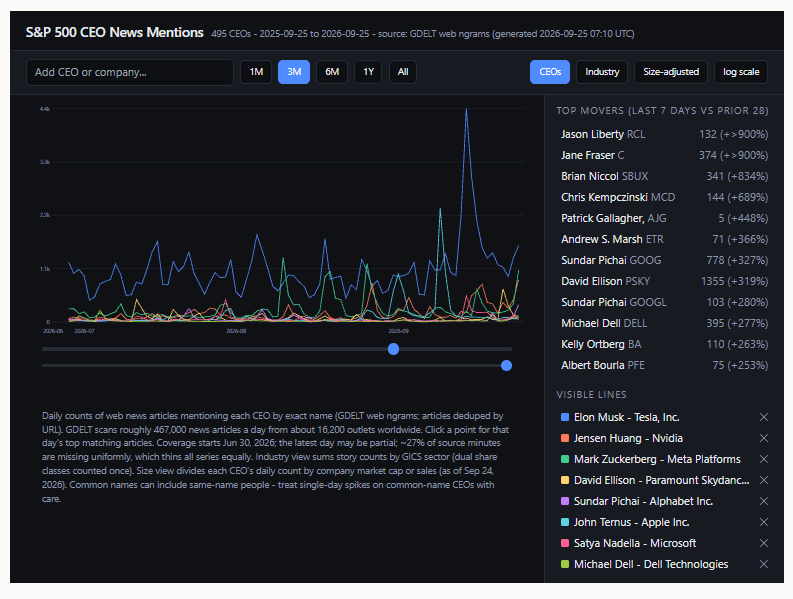
How often should a CEO expect to get covered by the legacy media?
For the median S&P 500 CEO, the answer is about 12 articles a month.
That’s based on 87 days of tracking mentions in GDELT, a global news database. The median CEO appeared in 34 articles over that period. Annualized, that’s 145 articles.
That doesn’t mean an article appears every three days. It’s simply a measure of total coverage. (And while the data isn’t comprehensive I think it’s directional.)
BTW I calculated this by leveraging the AI assistant Instinct. It recommended tapping into the GDELT database and also helped build the attached chart. It’s wild because I was part of a team that built a similiiar – but admittledly better system at Bloomberg – but that literally took years to build. This took like an hour.
CEOs don’t get coverage every day. On an average day, 163 of the CEOs in S&P 500 appear in at least one article. The number ranged from 109 to 219. Tuesdays through Fridays typically saw 175 to 185; on weekends, it dropped to about 125 to 130.
But the coverage is wildly uneven.
There were about 2,770 CEO-matching articles on an average day. Elon Musk alone accounted for roughly 1,070 of them. Over the 87 days, Musk appeared in 92,865 articles. Mark Zuckerberg appeared in 22,289. Jensen Huang appeared in 15,407.
Nine CEOs had no matches at all.
These numbers include syndicated articles and repeated coverage, so they measure overall news volume rather than unique stories or independent editorial decisions.
And this is a tiny slice of the broader news stream. On one full day in the dataset, GDELT carried 467,469 articles from 16,233 domains. In a separate 19-day sample of CEO coverage, the database included 1,983 different domains, including Yahoo Finance, Fortune, CNBC, Forbes, Business Insider, MarketWatch and Barron’s.
GDELT stands for Global Database of Events, Language, and Tone. It was created by Kalev Leetaru, with contributions from political scientist Philip Schrodt and others and started in 2013. It monitors news in more than 100 languages, with data back to 1979.

