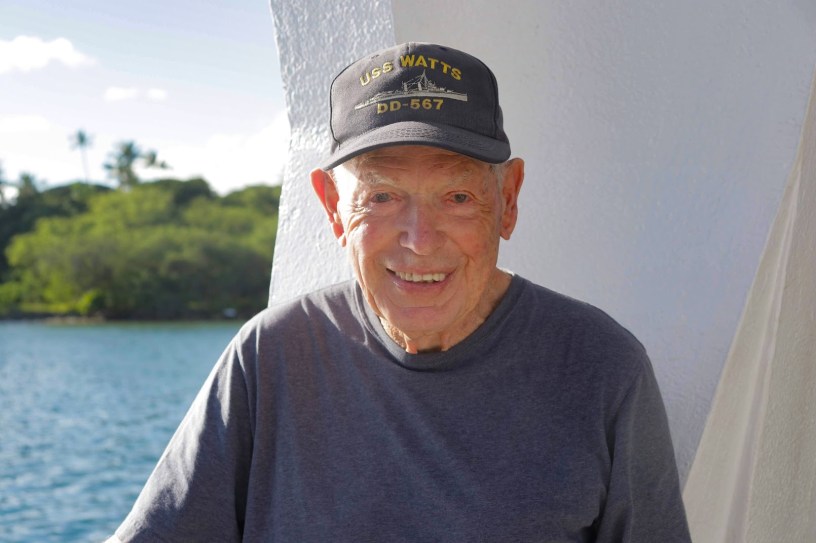
We are heartbroken to share that my father, Norman Merz, passed on April 20. He was 99.
Dad was born in Newark, grew up in South Orange during the Depression, served in the Navy during World War II, and then married Patricia Powell and raised a family in Madison. They retired to the Jersey Shore.
He worked almost four decades for the state electric utility, Jersey Central Power & Light, rising to head the systems operations division.
Dad lived most of his life within a few hundred square miles of northern New Jersey, and yet he witnessed an extraordinary array of events.
As a boy, he saw the Hindenburg glide down the coast shortly before it crashed at Lakehurst. He was on the beach the night the ocean liner Morro Castle ran aground in Asbury Park.
He was a sophomore in high school when Japan attacked Pearl Harbor and remembered listening to President Roosevelt’s “Day of Infamy” speech live in the school auditorium.
He survived New Jersey’s worst train accident, when the Broker crashed in 1951, killing 85. He saw Joe DiMaggio in Yankee Stadium during his 56-game hitting streak and watched Jackie Robinson play in the minor leagues.
Norman Cyphers Merz was born on Dec. 3, 1926, the middle child of Harold Oscar Merz and Mildred Cyphers Merz. He was predeceased by a brother, Stuart, and a sister, Shirley.
He was proud of attending Columbia High School in Maplewood, N.J., where he was on the state championship swimming and diving team. After the war broke out, he enlisted in the Navy even though he was color-blind—a problem he solved by cheating on the vision test.
He graduated from Cornell in 1949 with a degree in engineering and went back into the Navy to finish his service before starting work.
The Jersey Shore was a constant backdrop in his life. His grandfather owned a summer house in Elberon, and on weekends he lifeguarded at Allenhurst. Later, he would spend summers during his 30s with friends renting a place in Bay Head.
Dad was methodical, steady, and kind. He was frugal, but not cheap. He had quirky habits he didn’t tell anyone about unless they asked. For example, he always took the stairs at work to get in more exercise. In his office, he marked the spot where the sun hit the wall at 7 a.m. so that over the course of the year you could plot the elliptical arc.
We discovered that he kept a detailed schedule for rotating the mattress and the rugs in the living room so they wouldn’t wear out so fast, and logged the price and year of everything durable he bought, from trash cans to the hot water heater.
He had strong opinions about the “correct way” to eat pancakes (make four cuts, rotate the plate, and make four more before applying syrup) and eat corn on the cob (eat across, four rows at a time).
He wasn’t outwardly sentimental but displayed keepsakes on his dresser, like a trophy for finishing second in the 1941 Allenhurst Beach Club shuffleboard tournament and a photo of the USS Watts, the destroyer he served on in the Navy.
Dad started lots of projects and didn’t like to leave them unfinished. He began collecting beach badges in the 1960s and was alarmed earlier this year to realize he was missing a few. He reached out to a neighbor and managed to fill in the gaps.
He chose Pearl Harbor Day in 1963 to propose to my mom so he could remember the date, and he did it at Washington Rock to remember the place. They were happily married for 62 years, and during the years he was working, he drove home at noon every day so they could eat lunch together.
Dad was dedicated to family, friends, and community. He helped set up the recreation soccer league in Madison and coached some of the soccer and baseball teams my brother, sister, and I played on. He was a founding member of the Short Hills Ski Club.
My parents had a close-knit group of friends from the Madison Presbyterian Church with whom they went skiing and celebrated holidays. Later in life, the group took bike trips in Europe.
Dad was physically and mentally fit. He refereed high school soccer into his seventies. He skied at 90. He could recall details from football games that took place in the 1940s. He once won a free ski pass by reciting from memory the Gettysburg Address.
His longevity and health were a point of pride. He kept in good shape by staying active, eating three meals a day, and never going back for seconds or snacking. He swore by a glass of milk with dinner. He never smoked and rarely drank.
He would express himself in folksy aphorisms like: “You can’t learn to swim without getting your head wet” or “If you play with the bull, you get the horns.” Not much of a conversationalist, he was nevertheless eloquent when saying grace or making a toast at weddings.
Dad prepared for everything and took care of everyone. When he had cataract surgery two decades ago, he knew he wouldn’t be able to see afterwards and anticipated that I would have no idea how to drive home, so he prepared in advance instructions and a map that he left for me in the glove compartment.
In recent years, Dad’s eyesight deteriorated to the point that he was effectively blind. But he adapted stoically. He counted the steps from room to room and the stairs in the house and navigated effectively without assistance.
In recent weeks, he repeatedly told me how fortunate he had been in life and how much he loved his wife and children.
To my knowledge, there was just one thing he regretted: not skiing Tuckerman’s Ravine in New Hampshire.
He planned for everything, including this obituary. A few months ago, he asked me if I could help draft something. He then told me to go into his office and look in the bottom drawer of the filing cabinet for a folder where he had collected samples to use as inspiration.
He is survived by his beloved wife Patricia and three children: myself, Richard, and Carlyn. He loved and was loved by six grandchildren: Logan, Jackson, Hayden, Clara, Ali, and Samuel.
We will all miss him terribly.

