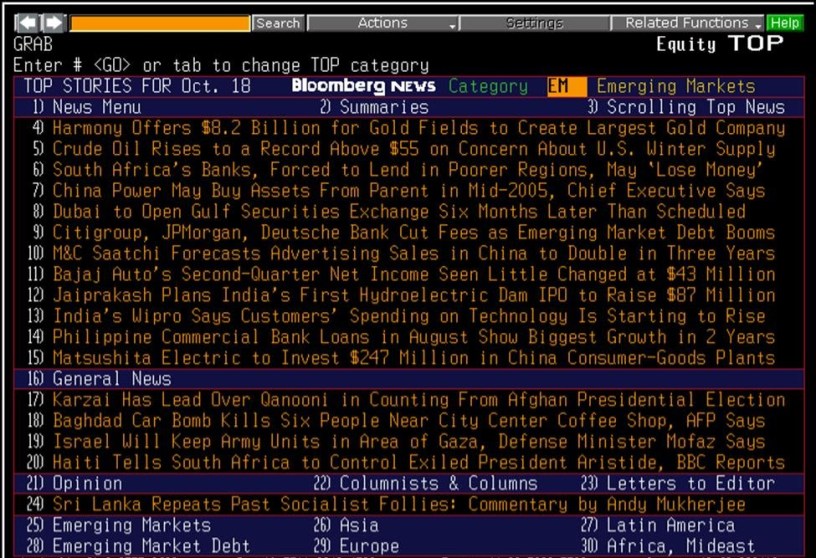
The Bloomberg terminal’s most visible application is TOP <GO>. I just learned the backstory of the function used by almost all traders and portfolio managers on Wall Street.
For those unfamiliar with Bloomberg, TOP displays the biggest news stories in order of importance. It’s maintained 24/7 by a cadre of dedicated editors.
And it all started because of a visit to one customer, New York based hedge fund Moore Capital.
The traders complained to then Editor-in-Chief Matt Winkler that news on Bloomberg was a relentless blizzard of headlines, a river of information.
What they needed was a place to find the most important stories of the day. At the time, Bloomberg displayed news by topics or company news. Every new story pushed the stack down, making it hard to find the big items.
While still at the client, Matt called Brian Rooney, then Princeton Bureau Chief. Overnight, Brian jerry-rigged a manual solution by creating a single new topic code and re-publishing 20 stories in reverse order of importance, effectively creating a screen of the biggest articles in descending order.
It was as immediate and effective a workaround as it was impossible to maintain. Anytime any story on the page was updated – even to change a comma – it would require republishing all 20 stories to keep the order. Brian said he spent a couple of days republishing batches for every tiny change.
Desperate, he reached out to Dave Heuwetter, an engineer who has since passed. Dave built a proper system which allowed editors to apply a code so the stories could be slotted into a section on a page that could be refreshed.
Editors became proficient at typing numeric commands such as 21 go, 6 go, 5 go, 3 go to arrange a story in any slot. The architecture Bloomberg runs thirty years later is essentially the one Dave set up.
Brian went on to oversee the team and managed the page until 2006. The page was among the most used functions on the terminal.
The page has undergone some cosmetic changes over time but it remains remarkably true to its original format. It’s still information dense, designed to cram in as many headlines as possible.
By highlighting the best work being done by reporters, TOP helped burnish Bloomberg’s reputation for serious journalism and established its credibilty as more than a data company that happened to publish articles. Bloomberg News has since won Pulitzer, Emmy, and Loeb awards.
Three decades later stories continue to be updated 24/7 by a global desk in New York, London, Hong Kong and Singapore.
Articles are rotated in and out of the page based on the news judgement of editors who anticipate what portfolio managers and traders need to know.
The humans haven’t been replaced by an algorithmic-driven solution because there isn’t one that can effectively select the “big” stories with the speed that traders require.
Maybe, that will change someday.
But not today.
(Part of a series on what I learned from 30 years at Bloomberg)

